So, after 5 days of nonstop 9+ pain, I gave myself a Toradol injection in the morning on Sunday, March 8th. The pain almost immediately dropped to about a 6. I ate a good lunch because the nausea was gone. I slept that night and my pain on Monday was around a 4 (very manageable!) I tried not to get too excited, but it’s hard not to. I ran some errands on Monday and had dinner. Slept great (5 hrs). Woke up on Tuesday with a 10+ migraine and nausea. Dammit! Can only use Toradol 2x a month due to warnings of severe liver issues. It was like a glimpse of what my life could be again. I’m thankful for the break and yet heartbroken it was so short.
Sorry for the silence, but have been hit once again with life-changing news. In the process of collecting doctor’s notes, diagnosis codes, and blood work results for my Disability Appeal Hearing, my lawyers asked me if I remembered being given a positive diagnosis for rheumatoid arthritis in 2008. I must have been in complete denial at the time, because I honestly had forgotten the doctor and the visit and I never went back. But what would you do if given a diagnosis of a debilitating, degenerative, incurable disease in your early 40’s?! I went on to consult with other doctors where I was diagnosed with fibromyalgia by my rheumatologist and chronic migraine by my neurologist/headache specialist. Now I must deal with a third chronic illness and it’s treatment and finding a medication that works and doesn’t kill me with side effects. Truly desperate and don’t think I can take much more! Please help! .
Please forgive me ahead of time, as i am in a particularly painful-filled, drug-addled state. In my viewing of my TL on Twitter and Facebook, I’m seeing so many fundraisers for things like raising money to go to a fan convention, to raise money for actors and actresses, to give someone a chance to meet an idol, etc. I’m not seeing that the recipient is ill or disabled, or desperate, for money. I understand everyone has the right to use these sites for their own purposes, but it hurts. When I’m at the lowest point in my life and reduced to begging for money for food and medicine, it hurts. Please think about those of us so in need that this is our last option and hope. Rant over. Please help!
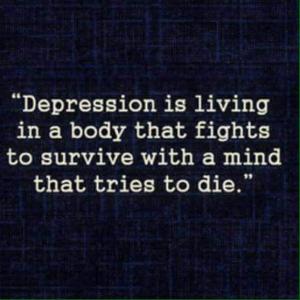
My depression has me in it’s grip right now. It’s like I’m on the outside looking in. I see a terrified woman curled up in a ball, sobbing uncontrollably. She’s in a dark room with no door. No windows. No way out! Trying so hard to catch a breath or form a thought. How long has she been in there?! Can’t anyone see or hear her?! Where are her family and friends?! Do they even know she’s there?! She’s not loud. It’s like she’s trying to hide the pain and anguish. Trying to make herself as small as possible. What could make her so scared, so sad, so utterly alone?! I can feel her hopelessness, her loneDepression, Anxiety, and Panic Disorder
liness, her complete agony and fear. I don’t see any blood or broken bones. Where is she hurt?! There’s nothing visible. It must all be on the inside. How much pain and suffering suffering must a body have endured to become this! This poor woman in the dark. I pray she makes it back into the light.
Sorry for the lack of activity here. It’s been a bad couple of weeks. Cymbalta “demon drug” detox continues, along with severe nausea, vomiting, pain, weakness, twitching, tics, involuntary shaking, uncontrollable crying, etc. Severely depressed and starting to wonder if there is an end in sight. My thoughts are dark. I’m doing everything possible to fight through this, but losing hope fast. If there is a light at the end of thiws tunnel, I’m not sure it’s where I want to wind up! Please read, study, ask about any meds you are given. Not just about side effects, but about withdrawal. As always, any donation would be greatly appreciated as my circumstances haven’t changed. Better days ahead?!
Update to anyone starting or thinking about starting Cymbalta. I know that this drug has worked wonders for many people and I in no way mean to downplay that. In my situation, I suffered side effects so bad that I had to discontinue asap. I had not been informed by my doctor or the drug insert packet about “Cymbalta discontinuation syndrome.” It is real and almost put me in the hospital. If this drug has or is working for you, congratulations. I’m jealous. Just heed the warnings and do your research if you need to go off of it or any similar drugs. Better days ahead.
So, I saw my GP on Tuesday. Not my favorite person by any means. He is brusque, snarky, condescending, under-educated about Migraines, and misinformed about new therapies and treatments. Why do I still see him?! My lawyer, who is fighting for my SSDI benefits, says it looks bad if I doctor-hop while waiting on my appeal hearing. I have already changed psychiatrists due to previous doctor being unable to see each patient as an individual and denying my right to medication refill without having an appointment. I had to cancel due to severe migraine (redundant) and my anti-anxiety meds ran out. I called and explained that I couldn’t get off the bed, let alone drive, and that I had no money for a cab and no one to take me. He flat out refused to give me even enough pills to et me by u til I could get in to see him. He quoted “office policy.” I was a dental office practice manager for 6 years. I treated each patient and situation on a case-by-case basis. It can be done. Anyway, I’m seeing a new psychiatrist next week. So, back to my GP issues. Knowing my history, the doctor walks in the exam room and says “So, how have you been?” I replied, “same.” He asked how work was going. I told him (again) that I hadn’t been able to work for almost four years. He said, “Oh, the headaches?” I answered, “No! The migraines!” How could he still not distinguish the difference?! I said, “I can’t just take a Tylenol and go to work!” He said, “So, you get a headache, it’s painful and miserable, then it goes away and you’re fine?” I think I almost yelled back, “No! My MIGRAINES don’t go away! I wake up with it and go to bed with it! It’s chronic and intractable and so far, not treatable!” His answer?! “How about a part-time job?” AARRGGHH! I’m so done! Next appointment is in 6 months, so please, let me have my hearing and benefits before then. So frustrated! I need to find a compassionate, empathetic doctor with knowledge and understanding of migraines and fibromyalgia. Wish me luck!
Why support migraine research?iStock_000022158549Small
Migraine is an exceedingly common disorder that causes substantial pain, disability and societal burden. Unfortunately, most of the biology that causes migraine is poorly understood. Many treatments are insufficient, inadequate, or associated with significant risks, such as overuse, abuse or addiction. Ongoing funding is needed to support migraine research and educational efforts are needed to further improve the quality of care of those with headache.
What do we know about migraine?
Recent studies show that migraine is associated with a change in communication (excitation) of cells in the brain compared to those individuals without migraine. However, why and how a migraine headache starts remains a mystery. We do know that once a migraine starts, there is activation of the pain fibers around the tissue (dura) that surrounds the outside of the brain. We also know that there is clear activation of the trigeminal nerve (shown in yellow), and is responsible for relaying pain information from the head and face, to the brainstem region. From the brainstem, pain information travels to the higher brains centers such as the thalamus then on up to the cortex.
Limitations with current therapies
Currently, there is no cure for migraine. Treatments are aimed at reducing headache frequency and stopping individual headaches when they occur. Some of these therapies used to stop the pain can be overused or abused, leading to further deterioration of their headache condition. Prophylactic treatments reduce headache frequency by approximately 1/2 in only about 40% of patients who take these medications. Many of these medications are associated with side effects, which limits their use. Because of these limitations regarding headache treatments, ongoing research is needed to further understand the biology and genetics behind the disease so treatments can be specifically targeted to treat each patient’s headache condition. Additional funding is also needed to further explore new therapeutic options that may work in patients who do not respond or cannot take currently available migraine medications.
Current State of Funding in Migraine
Migraine research receives very little funding. This is true when considering the total amount of funding and funding adjusted for migraine prevalence, disability caused by migraine and the societal costs from migraine. The National Institutes of Health (NIH) is the major source of governmental research funding in the United States. The NIH allocates only 0.012% of its research budget to headache research.
In 2013 the NIH granted only $19 million for migraine research. Diabetes received $1,007 million in 2013. Asthma received $207 million in 2013.
The amount of funding that the NIH spent on migraine research in 2007 is equal to only $0.36 per person with migraine. Diabetes received $49.38 per person with diabetes. Asthma received $12.25 per person with asthma.
This blog entry moved me to tears! This woman is strong, independent, brave, and everything I hope to be one day!
invisible me
This is a photo of me… photo-shopped to make me grey and invisible, as that is how I am feeling right at this moment. My illness is invisible, however I am not, and this seemingly gives people the right to ridicule me in public, it’s not fair and I want it to end. Not just for me but everyone who goes through embarrassment like I did today.
I will not use my walking stick just because it provokes your compassion, I will not do anything to the detriment of my own independence, just so you can see my illness and not take the piss out of me.
You wanna know what happened?
OK.
Today, no less than 3 hours ago, I was in the Ramsgate Waitrose store very close to my home (that I traveled to, 1 stop by bus), getting a few bits for dinner this week. I was having a particularly good day, and went without my walking stick, I knew I would be able to hold onto a trolley in the store, and this is always more helpful than the stick is anyway! I felt good to get out of the house and mingle in the community a little bit. I start work again soon, and I’m trying to build my tolerance/strength up.
I haven’t been able to carry a shopping basket for several years due to serious pain building up quickly in my arms. They are not an option for me so I chose a shallow trolley.
I went to the meat aisle and placed four items into the trolley and went to the checkout, there was a small queue. I felt ok, calm and relaxed, when the man in front turned, chuckling to himself and said “That’s a bit lazy isn’t it?”.
I looked at him, smiling, bemused…
He went on “Bit lazy isn’t it, all that trolley for those few things?!!”.
I just smiled and shrugged my shoulders. He didn’t say a word more as he turned and tended to the 3 items he had carried to the checkout.
Normally I would gob off. Do the… “Actually I have a disability, I can’t hold baskets, it hurts me, holding onto the trolley helps me walk”…. But I didn’t say this, I stood in silence.
Those few chuckled words had reduced me.
Made me feel inadequate. That man shat all over my good day.
See it was only a few words that normally I could laugh off, explain, educate the misinformed gentleman about my plight and that of thousands others like me.
But in that moment, I was broken, reduced to silence.
I came home and cried.
See my illness really is invisible whilst you can see me. You see me, Lis, the lady in her mid 30’s, who looks younger, wears eyeliner and modern clothing. She’s standing in the line, getting shopping for her boyfriend because hes been hard at work and taking care of her for months with little thanks and she wanted to do something nice for him on this sunny Monday afternoon. He came home to her anger and tears.
Please think next time you see a lazy person, like…
A teen boy in the disabled seat on the bus
A man who gets a taxi just 5 minutes walk down the road
A woman with 2 items in her trolley…
Maybe next time you see a ‘lazy’ person… keep your thoughts invisible too. Chronic illness, learning disabilities, mental illnesses are very visible when you live with them.
Today I went to a tattoo artist, and for $60 I let a man with a giant Jesus-tattoo on his head ink a semi-colon onto my wrist where it will stay until the day I die. By now, enough people have started asking questions that it made sense for me to start talking, and talking about things that aren’t particularly easy.
We’ll start here: a semi-colon is a place in a sentence where the author has the decision to stop with a period, but chooses not to. A semi-colon is a reminder to pause and then keep going.
In April I was diagnosed with depression and anxiety. By the beginning of May I was popping anti-depressents every morning with a breakfast I could barely stomach. In June, I had to leave a job I’d wanted since I first set foot on this campus as an incoming freshmen because of my mental health. Depression took a lot from me, but one of the most difficult things that my mental illness snatched from me was the title of Summer Welcome Leader.
I got this tattoo as a promise to myself that I would never willingly end my sentence. I got it as a reminder to take this summer as a pause, and then to keep going strong next year. I also got this this tattoo to open up conversations between myself and other humans about mental illness, because as difficult as mental illness is, what’s more difficult is feeling stigmatized. Or like you failed. Or like people are feeling sorry for you. There’s no question that the stigma surrounding mental illness inhibits struggling humans from finding the help that they need, and I find this absolutely heartbreaking because I know I am not alone when I say that depression destroyed my GPA, my relationships with my friends, my involvement on campus, and much, much more.
So if one out of every four people struggle with mental illness, then why did I feel like I was they only person who had ever experienced this before? If 25 of every hundred people I pass on the street have a clinical need for psychiatric care, then why did I feel like I had to hide my shaky hands every time the panic hit my harder than a train or feel like I had to shove every suicidal thought on a shelf behind old dictionaries and behind classic novels where no one could find them? 30,000 people die from suicide every year and that’s more than twice that of HIV and AIDS but still I am embarrassed to tell you that I can’t get out of bed in the mornings.
Let me make this clear for those who don’t know me well: I am not who you would expect to be depressed. Let me say this louder for those in the back: you cannot put me in a box decorated with black nail polish and frequent trips to Hot Topic because you don’t wear depression like a necklace or put on anxiety like a hat. You cannot spot depression because you become depression.
I am depression and I am not the silent girl dressed in all black hiding in the back row of your lecture hall. I am depression and I the perfect picture of a 20 year old sorority girl at an SEC school. I am depression and I am oversized fraternity formal t-shirts and Nike shorts that hang off my frail, starved hips that the Greek town girls envy so much. I am depression and I am the shining face on my sorority’s executive board and the bright smile touring high school seniors around my beautiful, botanical garden of a college campus. I am depression and behind stylish sunglasses too big for my face and a resume too long for a college sophomore, no one ever knew that my illness had crippled me so severely that I spent 20 hours a day wrapped in blankets in my bed, trying desperately to fight away the bitter cold that had taken residence in my heart and mind.
I hid myself away in my 7 million dollar sorority house, tucked somewhere between “you bought your friends” and “can’t daddy’s credit card fix your problems?”. I called 250 women on my campus by the name of sister but I was still lying at the bottom of a lake, unable to breathe while, effortlessly, everyone around me grew gills. Because no one tells you what to do when your life becomes a ten-car pile up on the New Jersey turnpike in rush hour traffic. Because no one tells you how to tell the very people who framed your life and hung it up on the wall for everyone to admire the girl who has it all together that nothing is going right anymore. No one tells you what to do when the good days dwindle so severely that you can’t remember the last time you woke up and didn’t want to die.
I was 13-year old the first time someone told me that suicide was a selfish act. I was 15 the first time someone I knew killed themselves. I was 17 when I realized society conditions people to be disgusted with suicide. I was 20 years old when suicide started to make sense.
Every 16.2 minutes, someone takes their life. In the time you’ve been reading about the crippling disease that made me want to take my own life, someone just took theirs. And still, we shame and stereotype and stigmatize the people who need the most help and teach our children that having to ask for help is something we should feel bad about, when in fact sometimes strength is admitting that you don’t have any left.
Oftentimes I feel like depression ruined my life. It took so much that it’s become a desperate desire for something good to come from this horrible experience. My hope is that, because of my experience, I can be an advocate and champion for mental health awareness. That I can start conversations with girls in my chapter and students on this campus and hopefully influence someone’s life for the better.
I am lucky. I am lucky because I live on a campus where my therapy visits are free and my antidepressants only cost $10 and there’s a disability center that will help me get through my classes. I am lucky because I have a mother who believed me and supported me when I said I was depressed and never made it sound like my fault. I am lucky because I have a sister who drives all the way to Columbia to see me when I need it. I am lucky because I have a job with Mizzou Tour Team and bosses that aren’t afraid to sit me down and make sure I’m eating and sleeping and doing okay. I am lucky because I have Carter and Jackson and Esther and Jordan and Kenzie and Erin and Brittany and Jim and Grace and so many others who in their own individual way have weaved a support network so caring and strong that there was no chance of me ever falling through the cracks.
The problem is that people struggling far worse than me don’t have half the support I do. Mizzou saved my life. Not everyone has a “Mizzou”. So I will show my tattoo proudly and champion for the people who cannot champion for themselves. Every day that I say no to the dark thoughts depression tries to tangle my mind with, I am winning a battle that society has not made easy to win. I’ve learned a lot from my struggle with depression. Every day is another day of riotous and endless waves of transformation and as much as I wish it didn’t hurt so bad when it hit me, I can’t say that I’d change who I am or the struggles I went through.
Another thing: my tattoo is just slightly crooked. At first that bothered me. And then I remembered that life’s a little crooked, too. And now I love it even more. It’s hard to find a place to end this think piece, but I’ll end it with the quote that I keep on my computer screen at all times, so I never forget. I hope anyone that’s ever struggled with their mental health never forgets, either:
“You are worthy of breathing. Someday you will learn that.
So don’t ask yourself why you can’t be
Smarter
Stronger
Cuter
Because depression took a lot from you and you are still fighting to take it back.”
For more information on the tattoo I got, please visit http://www.thesemicolonproject.com. If you need help, please check out online resources or call the National Suicide Prevention Lifeline at 1-800-273-8255. And as always, ask for help. Never fear admitting you need more than you can give yourself.
Nearly one in four U.S. households has someone affected by migraines, according to the Migraine Research Foundation.
On about day nine of a 12-day migraine a couple of months ago, I might have confessed to one person that I sat down inside my house at the end of the day and just let myself cry.
I was beyond exhausted, and strained mentally, physically and emotionally. The normal one-to-two-day migraines I have experienced every few months since my mid-20s would not lift, and while manageable — I didn’t miss a day of work, but did work a couple of days from home — there wasn’t an end in sight, and I felt it would never go away. Even my loyal, can’t-live-without prescription, wasn’t working.
The front of my head, from temple to temple, was a constant source of pain, even if sometimes “just” dull pressure. The stabbing-feeling in the eyes (it would alternate eyes, thankfully), and the nausea took its toll. And after the first full week, a friend very quietly said, “I see it all over your face.”
I was beat. And as a woman, I’m not alone.
About 27 million women in the U.S. are affected by migraines. Total, 36 million men, women and children suffer from the disease — about 18 percent of women in the U.S., and about 6 percent of men, according to the Migraine Research Foundation.
June is recognized as Migraine Awareness Month.
Nearly one in four U.S. households has someone affected by migraines, with the disease most common during the peak productive years, between the ages of 25 and 55 years old, according to the foundation. There is a 40 percent chance a child will suffer from migraines if one parents suffers from them. If both parents suffer from them, the chances increase to 90 percent.
Nobody in my family suffers from migraines. But they have seen first hand how debilitating the disease can be.
While I was able to manage through my 12-day ordeal, there have been times in the past that I could not even get out of bed. There was another time when my daughter was about 8 years old, and had to miss summer camp one day because I could not even lift my head off the pillow.
There was a time it took an hour to email in sick to work because the glare of the computer screen was that strong. I would have called, but that would have required more effort.
There are times I can not speak above a whisper. Other times, there can be no televisions on in the house because any noise hurts too much.
There are times I drive while holding my head in my hand, begging for the ride home to go faster.
There was the time just this past weekend — while out of town, and without my prescription — that I started to text a friend to decline a dinner invitation. I stopped the text mid-way through because it hurt too much, and was too exhausting, to look at the phone and focus. My daughter offered to finish the text for me.
It was laughable the next day.
A migraine is a syndrome, a collection of symptoms that arise from a common cause. A syndrome may occur in a complete form, with all of the typical symptoms, in a less complete form, with some symptoms, or in specific groupings of symptoms, according to the foundation. A migraine is classified according to the grouping of its symptoms. Since symptoms vary widely, migraines are often misdiagnosed.
Many women with migraines tend to have attacks triggered by skipped meals, bright lights, stress and anxiety, alcohol (often red wine), caffeine (too much or withdrawal) and hormonal changes during the menstrual cycle, according to womenshealth.gov. It also lists lack of sleep (or too much) and weather changes as triggers.
Despite the 12 days, I know I’m lucky. I know I don’t have it as bad as some others.
Migraine sufferers experience visual disturbances, nausea, vomiting, dizziness, extreme sensitivity to sound, light, touch and smell, and tingling or numbness in the extremities or face, according to the foundation. While the symptoms and degree of severity depend on the person, I know I’ve got it pretty easy.
There have only been a few times when I didn’t think I’d live to the next day — and those who suffer know that is not an exaggeration.
I believe my first migraine was at age 26. I used to call them “one-day headaches,” because I didn’t know what they were. All I knew was that it forced me to the couch, leaving me unable to do much of anything. No type of aspirin worked. Aspirin is a joke to me now. Nothing over the counter works. Without knowing what was wrong, I used to just wait it out. And the next day, it was gone.
Over time, the migraines would sometimes increase to “two-day headaches.” But never three. Never, ever 12.
The one-to-two-day migraines continued for about nine years before it affected my vision. Sitting at a computer screen working, my vision became blurred in one eye. I thought something was wrong with the website I was on, so opened a new window. Same thing. I turned away from the computer, held a hand lightly over the “good” eye, and realized I was seeing water spots.
And I thought I was going blind — which is funny today. But not at the moment.
Nausea quickly settled in, and then the pain in the front of my head. I thought: “That’s the ‘one-day headache I usually experience,'” and called my doctor.
After blood tests, vision tests, a brain MRI and a lot of unanswered questions, I was finally diagnosed with having migraines.
Still, the question remained: What was causing the migraines? Over time, I noticed they intensified in pain and frequency as the weather changed. And when allergy season peaked. And after paying attention even further, noticed if there were several nights of little sleep, I would be burdened by another one.
We discussed these triggers when I finally saw my doctor last April on about day nine of my migraine. Allergies were at an all-time high during that time, with my doctor having noticed an increase in patients visiting for allergy relief. We relieved some of my allergy symptoms with antihistamines, and I was prescribed new migraine meds.
It worked. And three days later, I cautiously moved forward. I waited for the migraine to return, but it didn’t. And slowly, slowly, the exhaustion from being so sick eventually wore off as well, and I started to feel normal again.
This is one of the hardest diseases to try and explain to someone, because it is not a headache, and it’s hard for us to hear you compare your headache to our migraine. “The migraine sufferers” is not an exclusive club — it’s just one you don’t want to belong to.
Thankfully, sadly, we’re not alone in this. There are millions of us laying in dark rooms with cold cloths on our necks whispering quietly to others. There are millions of us continuing to work despite the pain and discomfort. And there are millions of us waiting for the pain to lift.
Kym Klass can be reached at 334-240-0144 or by email at kklass@gannett.com. Follow her on Twitter @kymklass, on the Living Well page on Facebook, or on LivingWellByKym on Instagram.
What is a migraine?
mi·graine
ˈmīˌɡrān/
noun
a recurrent throbbing headache that typically affects one side of the head and is often accompanied by nausea and disturbed vision.
But, really:
A migraine sometimes feels like there is a vice on each side of your head, and someone is cranking it to make it tighter and tighter until the pain is unbearable.
What not to say to migraine sufferers
1. “Do you still have a headache?” It’s not. A headache. Yes, that’s a two-word-two-sentence answer. Because sometimes it hurts that much to talk. The best question to ask would be: “How are you feeling?” and let the person answer, if they can.
2. “I think I had a migraine once.” You don’t “think.” Either you know, or you didn’t have one. Did you feel like vomiting? Was your vision blurred? Did your head feel like it would explode when you lowered your head below your heart? Did you feel you could not open your eyes? Could you not speak above a whisper?
3. “I had a headache that felt like a migraine.” No, you didn’t.
For more information
To learn more, visit the Migraine Research Foundation online at http://www.migraineresearchfoundation.org.





 So, I saw my GP on Tuesday. Not my favorite person by any means. He is brusque, snarky, condescending, under-educated about Migraines, and misinformed about new therapies and treatments. Why do I still see him?! My lawyer, who is fighting for my SSDI benefits, says it looks bad if I doctor-hop while waiting on my appeal hearing. I have already changed psychiatrists due to previous doctor being unable to see each patient as an individual and denying my right to medication refill without having an appointment. I had to cancel due to severe migraine (redundant) and my anti-anxiety meds ran out. I called and explained that I couldn’t get off the bed, let alone drive, and that I had no money for a cab and no one to take me. He flat out refused to give me even enough pills to et me by u til I could get in to see him. He quoted “office policy.” I was a dental office practice manager for 6 years. I treated each patient and situation on a case-by-case basis. It can be done. Anyway, I’m seeing a new psychiatrist next week. So, back to my GP issues. Knowing my history, the doctor walks in the exam room and says “So, how have you been?” I replied, “same.” He asked how work was going. I told him (again) that I hadn’t been able to work for almost four years. He said, “Oh, the headaches?” I answered, “No! The migraines!” How could he still not distinguish the difference?! I said, “I can’t just take a Tylenol and go to work!” He said, “So, you get a headache, it’s painful and miserable, then it goes away and you’re fine?” I think I almost yelled back, “No! My MIGRAINES don’t go away! I wake up with it and go to bed with it! It’s chronic and intractable and so far, not treatable!” His answer?! “How about a part-time job?” AARRGGHH! I’m so done! Next appointment is in 6 months, so please, let me have my hearing and benefits before then. So frustrated! I need to find a compassionate, empathetic doctor with knowledge and understanding of migraines and fibromyalgia. Wish me luck!
 Today I went to a tattoo artist, and for $60 I let a man with a giant Jesus-tattoo on his head ink a semi-colon onto my wrist where it will stay until the day I die. By now, enough people have started asking questions that it made sense for me to start talking, and talking about things that aren’t particularly easy.
 The Road So Far - My Journey