10 Ways Migraine is Not “Just a Headache” By Kerrie Smyres—July 18, 2014

10 Ways Migraine is Not “Just a Headache”

By Kerrie Smyres—July 18, 2014

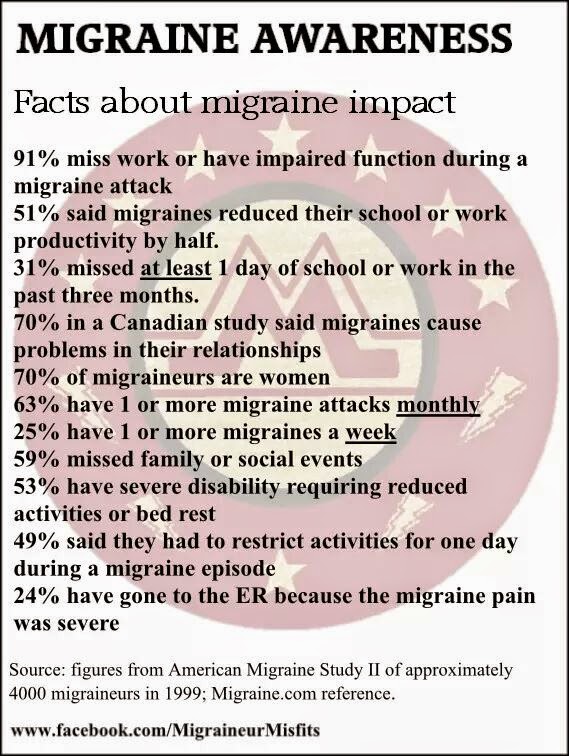
Migraine is a neurological disorder that’s largely inherited and migraine attacks are terribly painful and often disabling. Sadly, though, migraine is frequently dismissed as “just a headache” and migraineurs are told to take an aspirin and get over it. But those of us with migraine aren’t making a big deal over a measly headache. Here are 10 characteristics that separate migraine from a run-of-the-mill headache.

1. Pain Severity

A typical “bad headache” has nothing on the pain of a migraine. Migraine pain is most often described as throbbing or pulsating. Depending on the person, it can feel like one’s head is literally about to explode or collapse on itself. Some people have sharp stabbing or burning pain. And many have some combination of these types of pain.

2. Pain Location

Most people with migraine (59%) have pain on only one side of the head, but many have it on both sides. Those with pain throughout the head can also have more intense pain on one side than the other. The pain can be located anywhere on the head, including in the eyes, sinuses, roof of mouth, ears or face.

3. Pain Worsens With Movement

Migraine pain worsens with movement. Rolling over in bed can be excruciating. Some people will forgo getting up to get medication or water or to go to the bathroom because walking is too painful.

4. Nausea & Vomiting

There’s a common misconception that people vomit because the pain is so bad, but the nausea is a symptom separate from the pain (some people even have migraine attacks with severe nausea and no head pain). 73% of people with migraine have nausea and 29% vomit. Vomiting is never pleasant, but when any movement can worsen the pain, it is nothing short of horrific. Nausea without vomiting is nothing to scoff at. People with chronic migraine can lose unhealthy amounts of weight because they are too nauseated to eat.

5. Sense Hypersensitivity

Lights are too loud, sounds are too loud, odors are too strong and touch is irritating during a migraine. Any of these sensory inputs can actually cause physical pain.

6. So Many Other Symptoms

The primary symptoms people associate with migraine – pain, nausea, vomiting, sense hypersensitivity – are only the most common. Here are a handful of examples from the very long list of possible migraine symptoms: vertigo, difficulty finding words, numbness or tingling in the face or extremities, partial paralysis, frequent urination, brain fog, changes in heart rate and blood pressure. And there’s more, like the list of strange symptoms that Migraine.com readers reported.

7. Migraines Last for Hours or Days

A typical migraine attack lasts between four and 72 hours. The excruciating pain part is only one of four migraine stages. The “migraine hangover,” which happens after the worst of the symptoms pass, also includes a headache and can last for days. With chronic migraine that’s daily, one migraine attack runs into another, with no respite between attacks.

8. OTC Painkillers Are Often Ineffective

Over-the-counter painkillers, like aspirin, acetaminophen (Tylenol) and ibuprofen (Advil) are the go-to treatment for non-migraine headaches. They can be effective for some of people with migraine – especially with added caffeine – but they might as well be Tic-Tacs for most of us. Prescription migraine drugs provide relief for some people, but others get no benefit from any medication.

9. Disability and Disease Burden

During a migraine attack, 91% of people can’t function normally1 and 53.7% report severe impairment or the need for bed rest. The World Health Organization has found that migraine is the most disabling neurological illness by far and it ranks in the top 20 most disabling medical conditions worldwide.wpid-wp-1432820269510.jpeg WHO also found that “severe continuous migraine” (which some people with chronic migraine experience) is as disabling as quadriplegia.

Even between migraine attacks, a patient isn’t necessarily symptom-free and may experience anxiety about when their next migraine will occur and how severe it will be. Those with chronic migraine may not return to normal neurological function between migraine attacks.

10. The Stigma

Partly because migraine is perceived as “just a headache,” people with migraine face a huge stigma in addition to having disabling symptoms. A study published last year found migraine to be as stigmatized as epilepsy and people with migraine reported more difficulty working than those with epilepsy. Researchers also found that people with chronic migraine face a greater stigma than those with epilepsy or episodic migraine.
What is a migraine emergency? By Tammy Rome—July 31, 2015

wpid-wp-1432820181903.jpeg
Two years ago I was doing some last-minute shopping the night before Thanksgiving day. I started experiencing a prolonged aura that could have been the early signs of a stroke. After an hour of progressively worsening symptoms, my husband took me to the local ER for evaluation. All the tests were clear, so I was sent home with instructions to return if the symptoms recurred. Fortunately they never did. Even though it was a “false alarm”, that’s one ER trip I will never regret. Knowing the signs of a true migraine emergency is essential for every migraineur and caregiver.

People who say “Migraines don’t kill” have obviously never heard of these life-threatening complications, any one of which can be deadly if not diagnosed early and treated aggressively. We get so accustomed to tolerating the pain that it’s easy to forget how dangerous migraine can be sometimes. We take for granted that “…at least it’s not fatal” when we should be much more vigilant.

Migraines can kill.

There are four potentially life-threatening complications of migraine. Even though they are rare, learning to recognize the symptoms is essential for every migraineur. Knowing what to look for helps determine when it is appropriate to seek emergency help.

If you do end up in the ER with these symptoms, it is critical that you (or your caregiver) be able to clearly explain the symptoms that you are experiencing so that you get fast response to either rule out problems or get emergency treatment right away.

Status migrainosus
Migrainous infarction
Persistent aura without infarction
Migraine aura-triggered infarction
Status migrainosus

Any migraine attack that lasts longer than 72 hours should be evaluated by a doctor. Even if you are able to sleep through the attack or get temporary relief from taking medication, you still need to get it checked out. Doctors will want to rule out stroke and administer treatments to break the cycle. Sometimes long-lasting migraine attacks are caused by other problems such as medication overuse headache. However, status migrainosus must be ruled out first.

Persistent aura without infarction

Anytime we have an aura that lasts for 1 week, we should get it checked out. Again, your doctor should rule out stroke before giving this diagnosis. On rare occasions, persistent aura without infarction can last for years.

Migrainous infarction

This is what doctors are trying to rule out in order to make a diagnosis of persistent aura without infarcition. It appears like a typical migraine with aura except that the aura lasts for longer than 60 minutes. When tested, an MRI or CT scan will show evidence of a stroke. This is distinct from the increased risk of stroke in younger patients (under 30) with migraine with aura.

Migraine aura-triggered seizure

The name is pretty self-explanatory. It is a seizure that is triggered by a migraine attack and typically occurs within the first hour during or after a migraine attack. Patients with epilepsy often experience migraine-like headaches just as the seizure is ending. When a seizure follows a migraine attack, is it commonly referred to as “migralepsy”, although the more accurate diagnosis is migraine aura-triggered seizure.

Of the four complications of migraine, only status migrainosus is seen in patients with migraine without aura. The other three are only seen in migraine with aura. Since none can be accurately diagnosed without at CT scan or MRI and time may be critical, the ER is best equipped to determine the level of your emergency, rule out life-threatening issues, and provide the right interventions should you experience one or more of these migraine complications.

Print off this article.
Memorize these symptoms.
One day your life may depend on it.

In addition to the situations listed above, please ensure that you discuss any symptoms that are new or different with your physician or a healthcare professional. While migraine symptoms can change over time, it is essential to rule out any other underlying causes for your symptoms.

WHEEL OF FIBRO!

Let’s just wake up this morning and spin that wheel! Where will my pain be today? *spins wheel* Only went halfway around due to lack of strength. Try again. There we go! Crying from pain of spinning. Okay. Choices? wpid-wp-1432820161178.jpegLeft wrist, right side of neck, one or both legs, either shoulder, lower back, right hip, head, elbow, or…. oh yay… EVERYWHERE! Big winner!

How about symptoms?! Let’s spin again (if I can hold the wheel because of weakness in my hand!) *spins* OW! Shooting pain from fingers, through wrist, elbow, into neck. Typical. Where did we land? Brain fog? Aphasia? Nausea? Vomiting? Vertigo? Insomnia? Anxiety? Fatigue? Depression? Cognitive impairment? Spasms? Oh look! Lucky me! I landed on “All of the above!” Couldn’t even get a break and lose a turn. Oh well.

Let’s go into the final spin to find out the consequences of my previous spins. *spins wheel one last time* Son of a……. I think I tore a tendon that time. Inability to work, financial struggle, loss of friends, stigma, medications I can’t afford, side effects I can’t abide, depression, anxiety, loss of self, guilt, worthlessness, being a burden……. No way! Third times a charm! I got “all of the above” again! Wow! I’m really good at this! Shame there’s no prize money for the big winner. Oh well. There’s always tomorrow. 2016 will be a better year.

Family is closer than you think By Tammy Rome—December 17, 2015

Family is closer than you think
By Tammy Rome—December 17, 2015wpid-wp-1423238659414.jpeg
Human beings are not designed to live in isolation. We do best as part of thriving, supportive communities in which each person has an important role to play. When migraine shrinks our world and threatens to isolate us from everything and everyone we love, our body, mind, and spirit are injured. We instinctively know that this is not how we were meant to live. It’s even worse when other people abandon or ostracize us.

The isolation and rejection of sick people is nothing new. It’s been a part of human civilization as far back as historians and archeologists can find. It doesn’t make it right or moral, just unfortunately all too common. You see, we also have a tendency to fear and reject anything or anyone we do not understand. That fear drives us to protect ourselves from potential dangers even when there is no risk at all.

Why would anyone be afraid of migraine?
Well, migraine is an unsolvable puzzle. That’s threatening to most people, whether they admit it or not. Have you ever observed someone else having a migraine attack? It’s uncomfortable to watch. There’s all this pain and suffering that defies resolution. If it cannot be aborted, the attack must run a course that can last for days. An invisible force is in control. No wonder it was once thought to be caused by demon possession!

Few people in modern society would attribute migraine to such superstitions. That doesn’t mean the instinct to fear it has disappeared. We still blame the patient for not getting better. Migraine threatens our sense of security. To a healthy outsider, the attacks appear random and uncontrollable. Others naturally look for, and find explanations that do not implicate themselves or the culture they embrace. It’s just so much easier to walk away from a suffering migraineur than to join in their restrictive world. So the ancient practice of exiling the sick continues in modern time. We are left to fend for ourselves. Of course, loved ones and doctors may briefly step into our world to offer limited help. But they are not isolated. They get to resume life as part of the community. We stay isolated.

Or do we?
If we’re all ostracized, doesn’t that mean we’re all together? The latest estimate is that there are 38 million migraineurs just in the U.S. alone and over 1 billion worldwide. That means that wherever you go, one out of every 8 people has migraine. That’s a lot of people living in isolation! Why do we wrap our arms around ourselves and shut out the world? If we would just look up, we would find each other. We are all members of a misunderstood and feared community. But that community is not small. It is strong and vibrant. We need only to look around to find our migraine family.

Do you realize how powerful we could be? Think about the implications if we were to unite as a special interest group. What if we were to lobby, to petition our governments for better health care, more workplace accommodations, and migraine-friendly public places free of the sensory triggers that plague so many of us?

The trouble is that we all still think we are alone.

Nothing will change until we open our eyes to see that our family is waiting for us to wake up
Tammy’s first experience with Migraine started in 1975. Currently disabled by multiple pain conditions, Tammy still uses her expertise to help others. She holds a Master’s degree in Professional Counseling and is a skilled Herbalist and Reiki Master. She shares her extensive experience in both conventional and complementary medicine here at Migraine.com and on her own blog, Brain Storm.


16 Things Fibromyalgia Sufferers Need to Stop Doing by Julie Ryan @countingmyspoons

16 Things Fibromyalgia Sufferers Need to Stop Doingwpid-wp-1422496248237.jpeg

  1. Stop putting your own needs on the back burner. –If you have any sort of chronic debilitating condition, you need to put your own needs first. Even if you are the healthiest person on the planet, you shouldn’t let your needs go to the back of the line. Since Fibro is most common among women, this is especially true as women seem to be trained that their needs should come last after their husband, children, church, jobs, volunteer effort and anything else that could possible come before them. It’s any wonder we give ourselves any time at all; sadly, too many of us don’t.
  2. Stop spending time with the wrong people.- If someone is adding stress to your life, that stress is making you sick. Remove the stress by removing that person. You may not be able to completely remove them, but you can choose to avoid them when possible.
  3. Stop holding grudges. – Holding a grudge is an unnecessary stress. It causes us to create negative thoughts about a person when we do think of them and to only focus on those negative thoughts, when we should be trying to find ways to focus on more positive things. Let go of the grudge. You’ll still think of the person on occasion, but when you do just shrug it off and replace the thought with a thought of someone you care about that makes you smile.
  4. Stop trying to be everything to everyone. – The ability to say “No” is a highly under-rated one. Too often those of us with Fibromyalgia are likely to be unable to say “No”, feeling guilty when we can’t or won’t say “yes”. We can’t be everything to everyone, we can’t even be everything to ourselves and we don’t have to be.
  5. Stop lying to yourself. – You are sick, admit it. You don’t feel great. Someone else asks and you answer with “I’m OK” but it’s not the truth. It’s not the truth when you say it to them and it’s certainly not the truth when you say it to yourself.
  6. Stop wasting time explaining yourself to others. – Most people don’t care enough about you to care about your disease or disorder or why you can’t do what you can’t do. Keep it simple, just say “no” and move on. Don’t try to explain why you can’t do it, because they probably aren’t listening anyway.
  7. Stop trying to hold on to the past. – While you may be able to find ways to improve your symptoms, you’ll likely never be 100% again. There will always be limits. Stop trying to re-attain the levels of life you had before your illness and realize that was then and this is now. Focus on what you CAN do instead of what you used to be able to do.
  8. Stop berating yourself for old mistakes. – Guilt and blame are our constant friends. Stop beating yourself up over things you’ve done in the past (or things you wish you had done but didn’t). It’s in the past, let it go and move on. Again, focus on what you can do in the future.
  9. Stop being jealous of others. – It’s so easy to be jealous of what others have or what others can do. Little do we realize that they have limitations, too. No one sees the true life of another, their abilities or disabilities, their limits. Don’t judge your life based on the “Jones”, real or imagined. Focus on what you have that is wonderful.
  10. Stop complaining and feeling sorry for yourself. –Seriously! It’s ok to throw a pity party once in a while, but it should never last for more than 5 minutes and you should never invite friends.  Focus on the positives in life, there are many.
  11. Stop overlooking the beauty of small moments. –How many times have we heard that we should “stop and smell the roses”. You don’t really appreciate those small things until you can’t do them anymore. So, take a few moments each day and really think about the small things you were able to enjoy. Write them down so you can look back on them later when you are contemplating that pity party.
  12. Stop trying to make things perfect. – They already are. Ok, maybe they aren’t perfect, maybe they can even be better than they are now. But the point is that you need to focus on reality instead of perfection. Take small steps to improve things and get closer to the idea of what you want your life to be like, and not constantly worrying about how far from perfect you still are.
  13. Stop acting like everything is fine if it isn’t. –Everything is NOT OK, and it’s ok to tell the truth. When a real friend or someone who really cares about you asks how you are, be honest. Stop answering with “I’m fine” because you aren’t.
  14. Stop worrying so much. – You feel like life is out of control, and it is so don’t worry about it. Let life be what it’s going to be. Control the things you can control and let the rest go. Constant worrying will only make you feel worse.
  15. Stop focusing on what you don’t want to happen. – You don’t want to wake up tomorrow in a flare, so it’s all you think about and you end up keeping yourself from sleeping, which results in waking up in a flare. Sound familiar? Well, stop it. Instead of thinking “I don’t want…” think “I want….”. Focus on the good nights rest you know you WILL get and how great you know you will feel tomorrow because you made the right choices about the things that ARE in your control.
  16. Stop being ungrateful. – Be grateful, every minute of every day. There is something wonderful to be grateful for. Say “Thank You” for the small things and mean it. Instead of getting upset that someone did something that you intended to do because it made you feel “useless” or like they thought you weren’t doing your part, be thankful that they just freed you up to do something else you wanted to do.

When you’re told your migraine isn’t “real” By The Migraine Girl—November 27, 2015

When you’re told your migraine isn’t “real”   By The Migraine Girl—November 27, 2015

Chances are, if you’ve told anyone about your migraine diagnosis, you’ve gotten some very well-meaning advice from about half those people. “My aunt had migraines forever until she steeped rare Asian mushrooms in a tea made of cow urine—you should try it!” “My uncle had migraines but it turned out he was just allergic to his down pillow.” “I have seen eight thousand ads for Botox, so now’s the time when I ask you if you have tried Botox.”

I, like many of you out there, have heard a lot of advice. I remember that people’s hearts are in the right place and that they have no idea that, in fact, I have tried a lot of things to get my migraines under control.

Another type of feedback we hear frequently doesn’t have the same positive, thoughtful origins as well-meaning advice. This feedback consists of people’s doubt, ignorance, and disbelief. This is the sort of feedback you get that makes you realize that the person giving it isn’t trusting that your experience is real, and you can then decide if you want to make it into a teachable moment or just drop it

One thing I’ve encountered over and over again is stories from you all about others dismissing your migraine claims. Sadly, a lot of the time this feedback is coming directly from other migraineurs, migraineurs who have yet to really realize that migraine can manifest itself really differently in person to person and from attack to attack.

Here are the types of comments many migraine.com community has had to endure:

Your migraine isn’t real if…

…you can look at a computer screen

…you are able to drive

…you aren’t in bed in the fetal position in a dark room

…you are able to sit up

…you are able to speak

…you are able to move without vomiting

…you are able to maintain a conversation

…you can take care of your kids

…you can’t sleep through the night

…you can sleep through the night

…you can maintain employment

…you don’t see a headache/migraine specialist

…you don’t take preventive meds

…you haven’t tried every single thing in the world to “cure” yourself

…you don’t immediately take the advice of whomever you’re speaking with

…etc., etc.

Thank goodness for communities, both online and “real-life,” that can connect migraineurs to one another and allow us to learn about the intricacies of this very, very complicated illness. Thank goodness we have advocates and doctors encouraging us to keep track of our migraine patterns so we know how a migraine shows up in our lives. Thank goodness we have supporters—even if they’re just screen names on the migraine.com page or migraine.com Facebook page—that tell us to find another doctor when we tell yet another story of having the reality of our illness be dismissed.

Because I am now a fairly well-known migraine health advocate and writer, I sometimes encounter the reverse side of the problem a lot of you all have. That is to say, instead of telling me that my attacks aren’t real, many people I know—particularly friends and family I have here where I live in Athens, Georgia—dismiss their own struggle with migraine because they simply assume it’s “not as bad as what you go through.” Subjectively speaking, maybe I can agree with that a little bit at times: it’s true that my friend who gets one (count it) migraine a year doesn’t have the same sorts of challenges I do, but it doesn’t mean that her crappy yearly migraine attack isn’t really a migraine. Usually, though, I have to speak up and validate the other person’s experience, saying, “Migraines are a little bit different for everyone, and if you have a headache or migraine that is interrupting your ability to live a full life, I really hope you’ll see a doctor.” My migraine episodes are different than a lot of my friends’ episodes are, but that doesn’t make them any more real.

What do you have to say? Have you ever had the experience of someone claiming that your migraine isn’t real, either online or in person? How did you handle the situation? Or, are you more like me, encountering people who belittle their own experiences because they seem to think there can only be one really sick migraineur present? Please share your comments and stories below, or just add to my list above!
Bookshop owner & migraineur Janet “The Migraine Girl” Geddis moved around a bit in her early 20s before deciding to make Athens, Georgia her home

VIEW ALL POSTS BY THE MIGRAINE GIRL
SubscribeJoin 58,000 subscribers to our weekly newsletter.

wpid-fb_img_1422635977059.jpg

My Soulmate Sam

So…… tough day yesterday. After 3 hours of sleep, I had to decide which meds to take and when since my emotional support furbaby Samantha had a vet appointment at 10:00 am. I  was already stressed, as I always am when taking Sam out. She doesn’t like the car at all! And after many years of car rides = poking and prodding, she’s onto me. With her meowing pitifully in her carrier, we set off. Last visit, Dr. Hayden discovered 2 mast cell tumors that needed to be removed. Sam’s previously had 6 others (all benign, thank goodness) and I’m praying these are too. This is a rare situation in cats, and my vet consults with an oncologist at NC State and Duke for ideas on how to proceed. It seems that the only curative treatment is to remove them, leaving large margins. I hate to put my baby through this again, but I couldn’t live with myself if I didn’t do all I could. Samantha’s not only my best friend, my heart, my world, my soulmate, she’s also

wpid-fb_img_1424364382338.jpg
Don’t you cry no more!

my emotional support cat. She assists me with my chronic daily migraines, fibromyalgia, depression, anxiety, and panic attacks. She knows exactly what I need and when I need it. I don’t know what I’d do without her! As those that follow my blog are aware, I have been unable to work for close to 5 years due to my medical and emotional issues. I’ve been fighting for SSI disability benefits for 4 years. I finally won my appeal hearing on a bench decision from the Judge. That was in October. I’ve contacted my lawyer and SSA several times about hurrying the process. I don’t want to harass Social Security, but I am desperate. I asked for a compassionate allowance and was told they were working on it. In the meantime, I have no income, no savings, and no one to help me. I’ve started a gofundme.com/Samantha-wins for Sam’s surgery. If anyone can contribute, I’d be most appreciative. Donations can also go directly to Dr. Amanda Hayden, Centerville Animal Hospital, 300 Centerville Turnpike S, Chesapeake, VA 23322 (757) 482-9410. Every dollar is a blessing! Thank y’all for your love and support! It means the world to us! 2016 will be a better year! #AlwaysKeepFighting

Time Is(n’t) On Our Side

wpid-wp-1432820269510.jpegMy days are numbered. As are everyones. We are not immortal. We come with an expiration date. So it seems almost criminal to me to waste any of these precious days we’ve been blessed with having. Days are short. Twenty four hours go by in the blink of an eye. Weeks, months, even years fly by, leaving us saying, “where did the time go?!” Time marches on. Time waits for no man. No matter how hard we try to hold on to our youth, our kids youth, keep our parents from aaging, we cannot slow it down. So if we’re smart, we embrace it! Carpe diem! Live each day to it’s fullest! Do everything on your bucket list before it’s too late! Don’t procrastinate. Don’t say, “tomorrow’s another day.” Because it may not be! Nothing is promised, especially time. Things can change in the blink of an eye. As in my case. I went from living my life, to watching it pass me by. Chronic migraine and Fibromyalgia stopped me in my tracks. I used to go horseback riding, swimming, walking, trips to the beach. Now I’m lucky if I can get out of bed without falling. Or get out at all. These conditions have robbed me of my own free will. My choices. My own decisions. Planning and having something to look forward to doing. I have no guarantees that if I schedule something today for tomorrow, that I’ll be able to go. It’s an endless merry-go-round of missed appointments, broken plans,  disappointment, guilt, anger, depression. I fight! I push myself as hard as I can. But sometimes that’s not enough. My body wins out over my mind. I’m trapped in a mind that wants to go and a body that won’t allow it. I’m not done by any means. There are still medicines and treatments I haven’t tried. There are new meds and treatments in development. I won’t stop fighting because the alternative is too grim. So no matter what you’re facing, don’t give up on your dreams. Keep making plans. Keep writing your bucket list. This is the only life we get. Make the most of it. Every minute of every hour of every day. Stay strong and #AlwaysKeepFighting!

Carrying On (For Now)

Up at 3am daily. Habitually. Brief, drug-induced naps during day. Non-restorative sleep at night. Painsomnia. So tired, my tired is tired. Can’t shut my brain down. So many thoughts, fears, ideas, worries, anticipatory anxiety, and panic. 24/7. No breaks. My brain hurts. Migraine pain worsens from 9 to 12 on the pain scale. My anxiety and depression are through the roof. Worrying about things I cannot change. Stressing about situations I have no control over. Panic attacks are much more frequent. The pain meds make my thoughts murky. I don’t often remember things that I think of overnight. I hope they weren’t million dollar ideas! Maybe I should sleep with a tape recorder nearby. My stress lessened somewhat when I won a fully favorable decision on my appeal hearing for disability benefits. But it’s now been almost 2 months with no money or medical insurance. I’ve called SSA and was told my case was “being worked on.” That doesn’t help me pay my bills or have my chronic migraine treatment started. So, my stress level is back to 110%. I understand that the government is inundated with cases, but it’s been over 4 years since I started this entire process. I asked about a compassionate allowance to get benefits asap. I’m still waiting for a call or a letter. Nothing yet. So my pain is constant, as is my depression, anxiety, and panic. In the midst of all of this, my emotional support furbaby Samantha has developed multiple mast cell tumors. Surgery is the only way to guarantee the masses are fully cured. I hate to put her through the trauma and anesthesia, so hopefully 1 operation will be it. Sam is not only my therapy cat, she is my soulmate, best friend, confidante, pain reliever, comic relief, basically my everything, along with my Mom. They are the two most important figures in my life. I can’t imagine life without either of them. If you are able to help, Samantha has a fundraiser at gofundme.com/Samantha-wins or her vet is Dr. Amanda Hayden, Centerville Animal Hospital, 300 Centerville Turnpike S, Chesapeake, VA 23322 (757) 482-9410. Any amount is a blessing!

wpid-fb_img_1424364382338.jpg
Don’t you cry no more!

Samantha also has an Amazon Wish List. It would alleviate a lot of stress and make my heart lighter to know that at least she is taken care of! Bless you for your caring and support. Stay strong and #AlwaysKeepFighting!

What Not to Say to Someone With Migraine (cont’d)

newlifeoutlook | Migraine
What Not to Say to Someone With Migrainewpid-wp-1421975721526.jpeg
“Seriously, how can you have another migraine? Again?”

Well, they don’t seem to set a schedule for me to know when they will strike, so I don’t know why I have another one, but I assure you they will keep coming unless someone finds an actual lasting cure.

“You don’t look sick.”

That is because I push on through most of the time and continue with as much of my life as I can. If this struck you several days per month, wouldn’t you try and keep living your life too? It doesn’t mean I am not in agony — it means I am trying to keep going.

“You just need to get out more.”

With migraines you tend to retreat when you are under attack. But I do actually go out and do things, the same things people who don’t suffer from migraines do.

“You need to get more exercise.”

Exercise
is part of several things you can do to help control the number of attacks you may get, but it does not prevent or stop a migraine. I actually do exercise on my good days and, big surprise, it does not stop me from getting migraines.

“I think you thrive on sympathy.”

While I think everyone appreciates having someone sympathize when they are in excruciating pain, I am not “claiming” to have a migraine to get your sympathy. In fact, anyone who would suggest that as a reason probably lacks the required compassion required to provide sympathy to me. Sympathy can be nice, but what I seek is understanding and compassion.

“I wouldn’t take all those pain medications. Natural remedies are the only way to go.”

Well, I don’t love taking them either, but in the midst of a migraine I will honestly take whatever might possibly work. Natural remedies may help, but they do not alleviate the pain enough to rule out other medications that might. When you feel like your head is about to break open for three days straight, you are willing to take or do just about anything for relief.
I have found this miracle shake (or supplement) — you should try it!”

And you sell it, only you really just want to recruit me to your downline and make me auto purchase the stuff for hundreds of dollars per month. I have heard it from a number of people who say they are not “salespeople” and are only trying to share information and help people.

No, you are trying to build a downline and are preying upon desperate people to do so. Honestly, if there was a cure for major diseases the word would spread and doctors would get on board (yes, there are still some who care more about their patients and a cure than anything else). While supplements and such may help, just like natural remedies, I do not believe you have found a cure that is only available to me if I join your “team”.

I think people say some of these things to migraine sufferers because they simply do not think about what they imply or how their words can hurt or cause insult. The more awareness there is about the chronic condition, the more compassion and kindness can be offered in place of these disturbing remarks and suggestions.

Previous
1 2
Barbara Leech
Dec 1, 2015

© 2015 newlifeoutlook™ All rights reserved.