In The Dark

I always loved the sunshine. I adored the beach on a sunny day. I’d sit on the patio and stare up at the sky. My body seemed to crave the sunlight. It made me strong and positive. I left the lights in the house on. I felt safer in the light. I noticed I’d get depressed if I didn’t have enough light. I was more prone to bouts of sadness in the winter. Rainy days were days for me to reflect, think too much, and cry. It’s funny what a difference almost five years of chronic migraine and Fibromyalgia can make. Not funny like ha ha. Ironic funny.

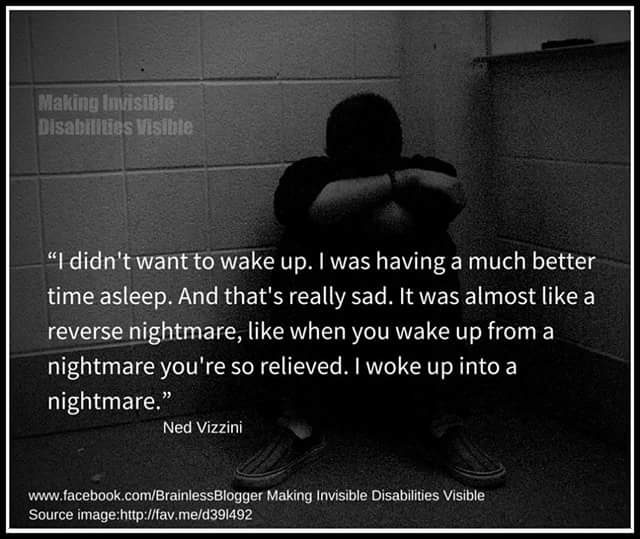
Now, I find comfort in the dark. I never used to. I feel safe here. I’m awake for most of the night. I record my thoughts. I read stories when the migraines allow. I just sit in the dark, curled up in my favorite chair. Usually with a lapful of purring tuxedo cat. Samantha lulls me into a comfortable state of mind. I don’t cry much at night. I’m almost content. The pain fades into the background. Maybe knowing I don’t have to do anything or go anywhere. There’s no stress. I can almost pretend that my life is normal.

Then morning comes. I’m rudely shaken from my safe place. It gets lighter outside. The birds and squirrels grab Sam’s attention. She’s off to the window. I think about what I need to get done. I wonder if I’ll get to do any of it. The pain comes back to the forefront. I’m stripped of my security bubble. I have to try to function. Act like a “normal” person. Deal with reality. Be responsible. In the light of day, it’s hard to hide. I don’t want to be seen. I’m not who I was before. It’s not as obvious at night. I can pretend things are okay.

I’ll struggle through this day because I have to. I’ll do what I can and try not to feel guilty about what I can’t. I’ll smile and, if asked, say I’m doing pretty well. The entire time just waiting for nighttime to return. To get back inside my cloak of darkness. My safe place. My world. wpid-img_20150323_064829.jpg

Midnight Ramblings

So I’ve been sitting here, alone, in the dark, just me and my thoughts. Never a good combination. I’ve been awake for hours. Got a few hours of tossing and turning in. Trying to get comfortable. Not able to find a good position. So much worse since I fell last week. Everything is bruised and/or scraped. I can’t tell which pains are from the fall and which are from the usual suspects (Fibro, migraine). It’s a strange feeling knowing that when most people injure themselves, once they heal the pain is gone. My bruises will fade. My cuts will heal. But my pain will remain. Not even a short respite. Doesn’t seem fair. But who said life was fair?! Like I said, me, alone with my thoughts, 2 iffy hours of sleep, not a good combo. Oh well, carry on fellow pain warriors. Do what you can and don’t push too hard. Better days ahead. I hope. wpid-wp-1432820304823.jpeg

Now This: Perimenopause May Make Migraines Worse Editor’s PickFebruary 3, 201

Attributing article from @MigraineAgain:http://migraineagain.com/now-this-perimenopause-may-make-migraines-worse/

Understanding the uproar over Zohydro ER JAMES PATRICK MURPHY, MD | MEDS | MARCH 30, 2014

wpid-fb_img_1424364439689.jpgIn March 2014, Zohydro ER (hydrocodone extended-release) was introduced to the market. Never in my medical lifetime do I recall a medication stirring such angst. Worries of mass overdoses, backdoor FDA conspiracies, and blatant disregard for the public well-being abound. Is there method to this madness?

Zohydro ER is a pain pill that, when taken by mouth, is released slowly over twelve hours. The active ingredient, hydrocodone, is an opioid (i.e. narcotic) that’s been around for decades in a short-acting pill form (e.g. Lortab, Vicodin, Norco) and has historically been combined with APAP (a.k.a. acetaminophen, Tylenol). The FDA considers hydrocodone-APAP combination pills to be relatively less addictive and designates them as a schedule 3 drug. Physicians can prescribe schedule 3 drugs over the phone, with up to six refills. By contrast, schedule 2 drugs (e.g. morphine, oxycodone, oxymorphone), even when combined with APAP, are considered more addictive, can’t be called in, and can’t be refilled without a new hard copy prescription.

Because it is effective for pain, relatively well tolerated, and convenient to prescribe, hydrocodone-APAP pills have become the most commonly prescribed opioid in the United States. It’s therefore not surprising that, since there’s so much in circulation, hydrocodone-APAP pills are frequently the most available opioid for abusers to abuse. Add to this the legitimate worry about acetaminophen (APAP) overuse causing liver failure, and you can understand our leaders’ concerns surrounding this pain medication.

Enter Zohydro ER, the first extended-release hydrocodone pill without APAP. It’s easy on the liver and lasts twelve hours; so people with around-the-clock pain may need fewer pills per day. Additionally, it’s a schedule 2 drug. In summary, Zohydro ER is a long-lasting version of a widely used and effective opioid, which until now had only been available in combination with acetaminophen. So why the controversy?

Zohydro ER does not have any of the new and popular tamper-resistant technologies; e.g. a matrix that won’t dissolve easily, or a coating that is difficult to crush. Instead, the makers took advantage of a delivery system (SODAS) already used successfully in a number other of extended-release drugs such as: Ritalin LA, Focalin XR, Luvox CR, and Avinza.
Oxycontin and Opana ER are two examples of opioids that manufacturers took off the market briefly for reformulation as tamper-resistant. However, while the changes have made them more difficult to snort or inject, many addicts still find ways to abuse these drugs or have just moved on to heroin. Tamper-resistant does not mean tamper-proof.

By the way, the generic form of Opana ER (oxymorphone extended-release) was not reformulated and is still available without tamper-resistant technology. Also, consider that Avinza (morphine extended-release), which employs the same sustained-release system (SODAS) as Zohydro ER, has neither been recalled nor been required to undergo reformulation. In reality, probably 90% of the opioids in circulation do not have tamper-resistant formulations.

That’s why I have difficulty understanding the uproar over Zohydro ER. As a pain specialist, I welcome another effective treatment to offer chronic pain sufferers. Sure, I’d be happier if it had a hard coating or some other “deterrent” to abuse. But in reality, Zohydro ER is, for all practical purposes, neither safer nor more dangerous than many of the drugs I already prescribe with success. So far, tamper-resistant innovations have not been proven to be effective in the big scheme of things. All opioids, regardless of the formulation, must be prescribed with caution and careful monitoring.
According to the American Society of Addiction Medicine, there are four main factors that contribute to a drug being addictive:

How much will it cost me? All things considered equal, people will choose a drug that is cheaper.
How fast does it get to my brain? Hydrocodone is water-soluble and actually diffuses into the brain slower than many other opioids.
What kind of a buzz will I get? Opioids stimulate the brain’s “reward circuit.” There is no proof that hydrocodone is any worse in this regard than other opioids.
How much of it can I get my hands on? People will abuse what is available to them. Since hydrocodone is the most prescribed opioid, expect it to be one of the most abused. It follows that if Zohydro ER floods the market it will be abused.
Therefore, my recommendations to physicians are:

Prescribe Zohydro ER in the lowest dose possible, for the shortest duration of time, and only if the benefits outweigh the risks.
Monitor regularly for effectiveness, side effects, and patient compliance.
Educate yourself and your patient.
Follow guidelines and regulations faithfully.
By the way, that’s my advice to physicians regardless of which opioid they prescribe.

Zohydro ER may not be tamper-resistant, but tamper-resistant drugs are not super heroes. Do not expect them to save us from the real villain.

The real villain is not the FDA, not the drug company, not the drug, and not the patient.

The villain is the disease of addiction.

Focus on the disease. Prevent the disease. Treat the disease.

This Zohydro hullabaloo is a prime opportunity to shine light on the problems surrounding prescription drug abuse and addiction. Let’s take advantage of it.

And stop the madness.

James Patrick Murphy is a physician who blogs at The Painful Truth. He can be reached on Twitter @jamespmurphymd.

A Placebo Treatment for Pain By JO MARCHANT JAN. 9, 2016

Note from Blogger. As a Chronic migraineur, chronic pain, and Fibromyalgia sufferer, I find this article just another slap in the face to all chronic pain warriors. The majority of us didn’t try opioids until all other options were exhausted. I, myself, fought the idea of pain management for several years due to the stigma. (Low income, drug abusers, criminals, etc.) I tried acupuncture, yoga, acupressure, biofeedback, supplements, minerals, vitamins, and many OTC pain relievers. When those didn’t alleviate my symptoms, I went on to the mildest drugs I could be prescribed. Then I took half the recommended dose. I’ve never been a fan of any type of drugs, legal or not, and I avoiding them at all costs. Until I needed them to get through my day. After trying Botox, beta blockers, antihistamines, preventives, and too many others to list, my headache specialist referred me to pain management. I had no choice. I couldn’t work, was fighting for SSI and SSDI Benefits, and was broke. My first visit, I explained to the doctor that I don’t like the way drugs make me feel. I was afraid of losing control. He prescribed Vicodin (lowest dose) and we went from there. I need these drugs to get through my life right now. When I receive some money from Disability, there are several treatment options I can try that don’t involve drugs. I may always need some help from narcotics and I pray that they’ll be available and not kept from me because I may abuse them. When your life is put on hold due to chronic pain, you change your perception on many things. Pain relief is number one. Carry on and Always Keep Fighting! Stay strong, Judi

wpid-wp-1432820269510.jpeg

A Placebo Treatment for Pain By New York Times

THE crisis of painkiller addiction is becoming increasingly personal: Sixteen percent of Americans know someone who has died from a prescription painkiller overdose, according to a recent Kaiser Family Foundation survey; 9 percent have seen a family member or close friend die.

Addictive opioid painkillers were once reserved for extreme situations like terminal cancer. But opioids like Vicodin and OxyContin are now widely prescribed for common conditions like arthritis and lower back pain. The consequences have been catastrophic: In 2013, prescription painkillers caused nearly 7,000 emergency room visits and 44 deaths every day.

How do we tackle this crisis? We often hear about efforts to clamp down on abuse, for example by regulating pain clinics and monitoring prescription patterns. But these won’t dent the demand for opioids unless we can find better ways to treat the hundred million Americans said to suffer from chronic pain. Simply switching to other drugs isn’t the answer. Few new painkillers are being approved, and existing ones, like Motrin and Tylenol, come with their own risks when used long-term, and some appear to be less effective than we once thought.

Help might instead come from an unexpected corner: the placebo effect.

This phenomenon — in which someone feels better after receiving fake treatment — was once dismissed as an illusion. People who are ill often improve regardless of the treatment they receive. But neuroscientists are discovering that in some conditions, including pain, placebos create biological effects similar to those caused by drugs.

Taking a placebo painkiller dampens activity in pain-related areas of the brain and spinal cord, and triggers the release of endorphins, the natural pain-relieving chemicals that opioid drugs are designed to mimic. Even when we take a real painkiller, a big chunk of its effect is delivered not by any direct chemical action, but by our expectation that the drug will work. Studies show that widely used painkillers like morphine, buprenorphine and tramadol are markedly less effective if we don’t know we’re taking them.

Placebo effects in pain are so large, in fact, that drug manufacturers are finding it hard to beat them. Finding ways to minimize placebo effects in trials, for example by screening out those who are most susceptible, is now a big focus for research. But what if instead we seek to harness these effects? Placebos might ruin drug trials, but they also show us a new approach to treating pain.

It is unethical to deceive patients by prescribing fake treatments, of course. But there is evidence that people with some conditions benefit even if they know they are taking placebos. In a 2014 study that followed 459 migraine attacks in 66 patients, honestly labeled placebos provided significantly more pain relief than no treatment, and were nearly half as effective as the painkiller Maxalt. (The study also found that a placebo labeled “placebo” was 60 percent as effective as Maxalt if it was labeled “placebo.” If the placebo was labeled “Maxalt,” it was again 60 percent as effective as the real drug under its real label.)
With placebo responses in pain so high — and the risks of drugs so severe — why not prescribe a course of “honest” placebos for those who wish to try it, before proceeding, if necessary, to an active drug?

Another option is to employ alternative therapies, which through placebo responses can benefit patients even when there is no physical mode of action. A series of large trials in Germany published between 2005 and 2009 compared real and sham acupuncture (in which needles are placed at nonacupuncture points) with either no treatment or routine clinical care, for chronic pain conditions including migraine, tension headaches, lower back pain and osteoarthritis. Patients who received the acupuncture, real or sham, reported a similar amount of pain relief — and more than those who received no treatment or routine care that included pain medication.

Rather than relying on dummy pills and treatments, however, a broader hope is that teasing out why and when placebos work — and for whom — will help to maximize the effectiveness of drugs, and in some cases allow us to do without them.

The available funding for such research is minuscule compared with the efforts poured into developing new drugs. But a key ingredient is expectation: The greater our belief that a treatment will work, the better we’ll respond.

Individual attitudes and experiences are important, as are cultural factors. Placebo effects are getting stronger in the United States, for example, though not elsewhere. Researchers reported last year that in trials published in 1996, drugs for chronic pain produced on average 27 percent more pain relief than placebos. By 2013, that advantage had slipped to just 9 percent. Likely explanations include a growing cultural belief in the effectiveness of painkillers — a result of direct-to-consumer advertising (illegal in most other countries) and perhaps the fact that so many Americans have taken these drugs in the past.

These findings have implications for deciding which patients are likely to benefit from drugs — someone who has strong faith in painkillers’ effectiveness is more likely to benefit than someone who is suspicious of conventional medicine — as well as how physicians explain the benefits and side effects of treatments they prescribe. Trials show, for example, that strengthening patients’ positive expectations and reducing their anxiety during a variety of procedures, including minimally invasive surgery, while still being honest, can reduce the dose of painkillers required and cut complications.

Placebo studies also reveal the value of social interaction as a treatment for pain. Harvard researchers studied patients in pain from irritable bowel syndrome and found that 44 percent of those given sham acupuncture had adequate relief from their symptoms. If the person who performed the acupuncture was extra supportive and empathetic, however, that figure jumped to 62 percent.

Placebos tell us that pain is a complex mix of biological, psychological and social factors. We need to develop better drugs to treat it, but let’s also take more seriously the idea of relieving pain without them. With dozens of Americans dying every day from prescription painkillers, we need all the help we can get.


Falling Apart

wpid-img_20150119_110400.jpg
Hope

So, I saw my pain management doctor last week. He upped the dosage on my pain med and prescribed a new med for inflammation and spasms. I read the info packet on the new med. (WHY?!) I’ll never take it now. Spontaneous heart failure, with no prior history. Could be fatal. I love the part that says “your doctor prescribed this medication because he/she feels that the benefits outweigh the risks.” The risk being death?! No thank you! My chronic daily migraine and Fibro pain make me feel like I’m dying sometimes, but I know I’m not really. And I’d like to keep it that way. I’ll ask for something less likely to kill me next time.

Anyway, yesterday I fell. I was already dizzy from the increase in dosage of my pain meds. I tripped over some books on the floor and where I used to be able to catch myself, not this time. I went down hard on my knee, elbow, shoulder, palms, and bashed my head on my cat’s plastic crate. I got up bloody, with a goose egg immediately forming on my forehead. My knee and shoulder hurt the worst, after my head. (Nothing better for a chronic migraineur than a head injury on top of it!) 😕 I didn’t have concussion symptoms so I laid down and hoped I’d feel better when I woke. WRONG!!! Everything hurt. I have cuts, bruises, bumps, broken blood vessels in my eye, and the beginnings of a nice shiner. I know nothing is broken, but I’m debating going to the doctor to get checked out. It sounds awful, but as my invisible illness warriors will understand, just having a medical professional see obvious marks on me gives me validation. I’ll keep everyone posted. Carry on and Always Keep Fighting! 💜


Constant Cancellations – the rare friend who can navigate chronic migraine

NOTE FROM JUDI – Holly, you are so lucky to have found such a great friend! This is my hope after losing many. Love to you both! Carry on and Always Keep Fighting!
Constant Cancellations – the rare friend who can navigate chronic migraine
 Profile photo of hollybee

It’s a rare find: the friend who can handle all the idiosyncrasies that come with chronic migraine.  The requests to find a quiet restaurant, to choose the chair that faces away from a bright window or light, to avoid certain foods, and to put up with endless last minute cancellations can challenge and confuse even the most patient and kind person.  For the friend of a migraineur, becoming knowledgeable about the many triggers can feel like a job in itself, with sensitivity to light, sound, smells and foods lurking around every corner.  However, the friend that can show understanding without judging these needs is key.  So many people with migraine have felt severe judgement for this invisible condition that often gets downplayed as “just a headache.”  “You don’t look sick” is an unintentional hurtful statement we’ve all heard before.

This condition has tested many of my long-time friendships and caused me to lose several shorter-term friends. The impact of migraines on those surrounding the sufferer is immeasurable:  The worry, constant changing of plans, and sense of helplessness is both paralyzing and crazy-making.

The ability to receive chronic cancellations and not take them personally takes a confident person who truly believes and accepts the condition of daily migraine.  The pain often causes the sufferer to retreat into into a dark quiet space until the storm has passed- and can make communication impossible for windows of time.  By its very nature, migraine is isolating.

People new to me or the subject of chronic migraine are both eager to solve the challenge and confident they can.  It’s a natural tendency to want to help someone feel better and to assume someone can get better.  I have been asked many questions and offered seemingly endless ideas until it becomes clear to my new acquaintance that this is a mystery that can’t be solved and rather is a condition that needs to be accepted.  Some are not comfortable with this arrangement.  I can end up feeling judged for not trying hard enough to “get better” when truly after over 30 years of doing just that, I’ve learned that while I continue to look for solutions, my energies are better spent on my family and getting along in life rather than engaging in a battle that can’t ultimately be won.

So while it is clear that chronic migraine can wreak havoc on any relationship, it is equally clear that those who emerge as steadfast friends willing to brave the relentless and repeated storms are phenomenal examples of warmth and kindness, patience, nonjudgmental flexibility, and acceptance.

Here’s to the core group of friends and family who have weathered this storm right along with all of us.  Your humor, patience, and love has meant the world in helping us face this challenge day after day.

Pic and quote from Judi.

wpid-fb_img_1422990380527.jpg


Emotional Rescue

wpid-wp-1432820287000.jpegIt happened out of nowhere. One minute I’m watching Supernatural on tv, my furbaby Samantha on my lap, relatively pain-light thanks to pain meds, the next minute tears are rolling down my face. No particular reason. I didn’t see a Folgers© commercial or have Sam claw me in a sensitive area. I just started crying. And couldn’t stop. My breath hitching as I tried to keep quiet and not let Mom hear. I hate for her to hear me and worry. The more I tried to hold it in, the harder it became. I started to have trouble catching my breath, could feel the signs of a panic attack beginning. My heart raced, I was sweating, and had chills. Dizziness and nausea came next. I tried breathing exercises to no avail. Samantha was purring and kneading on me, which usually helps. But I had waited too long and gotten too worked up. I got up and made my way to the bedroom for anti-anxiety meds. I took one with a big glass of water. I took a couple deep, cleansing breaths. Slowed my breathing. Eventually stopped crying and began to feel better. I scooped up Sam and sat back down in my chair. After a while, I began to doze and fell asleep to an encore episode of Supernatural which always eases my mind. My last conscious thought was Sam purring and wondering how much worse this panic episode would have been had I also seen a Hallmark© or Phone company commercial. I’m afraid I’m turning into a emo pile of mush. Hopefully, this too shall pass. In the meantime, carry on and always keep fighting!
2016 The Road So Far

Some days are better than others. I don’t mean a little better, but drastically better. Just like some days are worse than others. Much worse. Such is life with chronic pain. I don’t have good days as opposed to bad days anymore. I have a variety of low pain, extreme pain, high stress, low anxiety, panic filled, relatively bearable, can’t take it anymore days. Or hours. Or episodes. Time is broken down differently. I can’t foretell an entire day, so I break it down into small increments. I got out of bed. Success. I attempted to shower. Couldn’t do it. Will try again tomorrow. I got dressed for appointment with psychologist. Took my pills. Hit with wave of extreme exhaustion. Couldn’t hold my eyes open. Went back to bed. I guess 4 hours sleep last night didn’t cut it. Slept for an hour and pain woke me up. Got into chair with heating pad for lower back and ice for hip. Tried to eat. No appetite. Got frustrated thinking of all I had to do and couldn’t. Started crying. Exacerbated migraine. Took more migraine meds. Couldn’t stop crying. Took more anxiety meds. It’s now 9:00 am. Appointment is at 2:00 pm, 20 minutes away by interstate. Will the side effects let up by the time I have to leave?! Will I be able to wait until I get back home to take more meds. What if I get there and can’t drive home?! Dizzy and uncoordinated from meds. Can I drive?! What if I get pulled over?! Will there be a “missed appointment” fee?! Will Social Security get involved if I miss another appointment regardless of reason?! Depression and self-doubt. Guilt and self-pity. Fear. Why can’t I do simple things anymore?! Why does every part of my body hurt?! Why doesn’t the medication work?! Will I live the rest of my life like this?! Can I?! Do I want to?! Why is this happening to me?! My emotions are all over the place. My body hurts. My brain hurts. I’m physically and emotionally drained. I try so hard to stay positive. To believe that things will improve. I know this moment will pass. I’ve been through this so many times before. Deep breaths. In and out. Calming breaths. I can do this. I am stronger than this. I can beat this. I WILL beat this. Just not today. I’ll try again tomorrow. Better days ahead. wpid-wp-1422496248237.jpeg

2015 review of migraine research  

wpid-wp-1432820251735.jpeg
Profile photo of Tammy Rome

We have all heard that there are limited funds for migraine research, a shortage of qualified doctors, and infrequent launches of new treatments.  When was the last time you heard anything about what is actually being done to improvetreatment for migraine patients? The really great news is that researchers are working hard on shoestring budgets, trying to find better ways to help us manage migraine. They haven’t given up, so neither should we.

Here is where we stand right now.

Sumatriptan intranasal — Avanir Pharmaceuticals, Inc.
This new intranasal delivery device for low-dose powdered sumatriptan, ran into problems when subjects had difficulty using the device properly during clinical trials. In late 2014, the FDA declined to approve Sumatriptan intranasal until the company assess the cause of these user errors. Avanir planned to provide new data in 2015, but was acquired by Otsuka Pharmaceutical Co. Ltd. Since the acquisition, no new information has been released. Hopefully they will finish the job in 2016.

Semprana® (inhaled DHE) – Allergan, Inc.
Allergan has been working on an inhaled version of DHE that has received three FDA denials. The company announced FDA approval would come in mid-2015, but there’s been no news. I doubt this one will be available any time soon, if ever.

Lasmiditan — CoLucid Pharmaceuticals, Inc.
Phase 3 Trial: A Study of Two Doses of Lasmiditan (100 mg and 200 mg) Compared to Placebo in the Acute Treatment of Migraine: A randomized, double-blind, placebo-controlled parallel group study

If it gains approval, this will be the first triptan without vasoconstriction. This would be a boon for patients who cannot tolerate the side effects of vasoconstriction or for whom it is contraindicated. The Phase 3 clinical trial will enroll over 2000 subjects who all have risk factors for cardiovascular disease (making them ineligible to use current triptans). The study is projected to be completed in mid-2016. Let’s keep our fingers crossed that this one gets to market very soon!

Topofen™ gel (ketoprofen) – Achelios Therapeutics
Phase 1B Trial: Study to Determine the Efficacy and Safety of ELS-M11 in Acute Migraine

This one caught my eye because I used to be able to get ketoprofen over-the-counter. It was my preferred abortivefor years, working much better than Excedrin and almost as good as triptans. This topical ketoprofen gel can be applied to the skin over the 3 branches of the trigeminal nerve at the first sign of a migraine attack. So far, there has been one small Phase 1 trial with promising results. 45% were pain-free from 2-24 hours after application. 50% were pain-free after 24 hours. Unfortunately, there’s been no news about future trials.

Subcutaneous Histamine dihydrochloride – BioHealthonomics Inc.
Phase 2 Trial: A Multicenter, Randomized, Double-blind, Placebo-controlled Trial to Assess the Efficacy and Safety of Subcutaneous Histamine Dihydrochloride for Migraine Prophylaxis

In late 2013, filed an application with the FDA for a small human trial. Unfortunately, the study is still listed as “not yet recruiting.”

Intranasal Kinetic Oscillation Stimulation – Chordate Medical
Phase 2 Trial: A Randomized, Placebo-controlled, Double-blind, Multi-center Pilot Study to Evaluate the Prophylactic Effect and Tolerability of Intranasal Kinetic Oscillation Stimulation (KOS) Using the Chordate System S200 in Patients Diagnosed With Migraine

This study was scheduled for completion in 2015. We can expect trial results to be available sometime in 2016.

Intranasal Oxytocin (TI-001) – Trigemina, Inc.
Phase 2 Trial: TI-001 (Intranasal Oxytocin) for Treatment ofChronic Migraine
Study results are expected in early 2016.

Occipital Nerve Stimulation – Boston Scientific Corp.
Occipital Nerve Stimulation (ONS) for Migraine: OPTIMISE will evaluate the safety and efficacy of the ONS Precision System for the management of intractable migraine. Results are expected in June 2017.

Neuromodulation System – Scion NeuroStim
A Non-Invasive Neuromodulation Device for Treatment of Migraine Headache
This study is scheduled for completion soon, so watch for results late in 2016.

MLD10 (magnesium l-lactate dehydrate) – Pharmalyte Solutions, LLC
Phase 2/3 trial: MLD10 in the Prevention of Migraine in Adult
This study is scheduled for completion in late 2016 so results won’t be available until 2017.

MK 1602 (Small molecule CGRP antagonist) – Merck & Co. (acquired by Allergan)
Phase 2 trial is complete. Phase 3 study to begin soon. Watch for details coming later this year. This is the only oral CGRP antagonist currently in development.

LY2951742 (humanized CGRP antibody) – Eli Lilly and Co.
Phase 2B: Randomized, Double-Blind, Placebo-Controlled Study of LY2951742 in Patients With Episodic Migraine

Results were reported in 2015 showing that this once-monthly injection safely reduced migraine headache days for episodic migraineurs. This confirmed previous study results. No word on the start of Phase 3 trials. However, Lilly has initiated two Phase 3 trials for episodic and chronic cluster headache. The FDA fast-tracked these trials based on the severity of cluster headache and the woeful lack of available treatments. If it succeeds, this will be the first preventive for cluster headache in history.

ALD403 (CGRP antibody) – Alder Biopharmaceuticals, Inc.
Phase 2B trial: A Parallel Group, Double-Blind, Randomized, Placebo Controlled, Dose-Ranging Phase 2 Trial to Evaluate the Efficacy, Safety, and Pharmacokinetics of ALD403 Administered Intravenously in Patients With Chronic Migraine

The study of this genetically engineered humanized CGRP antibody began in late 2014. News of the results are expected in early 2016.  Alder also initiated a Phase 1 study to investigate quarterly self-administration of ALD403. Following announcement of the results (also in early 2016), a Phase 2B study will determine optimal dosing for episodic migraine patients. Alder also has a Phase 3 trial planned for high-frequency episodic migraine and one for chronic migraine.

TEV-48125 (humanized CGRP antibody) – Teva Pharmaceuticals
Phase 2 trial: A Multicenter, Randomized, Double-Blind, Double-Dummy, Placebo-Controlled, Parallel Group, Multi-Dose Study Comparing the Efficacy and Safety of Subcutaneous LBR-101 With Placebo for the Preventive Treatment of Chronic Migraine

Phase 2 trial: A Multicenter Assessment of TEV-48125 in High Frequency Episodic Migraine

TEV-48125 is a humanized monoclonal antihuman antibody that binds to CGRP, blocking its ability to interact with human CGRP receptors. The results of two Phase 2 trials published in 2015 generated a lot of excitement within the migraine community because 15% of the subjects treated with the drug experienced a full 12-week remission of migraine headache symptoms. 11% experienced a 75% reduction and 53% experienced at least a 50% reduction in migraine days. Even better, no serious side effects were reported. We’re still waiting for news about Teva’s plan for Phase 3 trials.

AMG 334 (fully human CGRP receptor antibody) – Amgen
Phase 2 trials:
A Phase 2 Study to Evaluate the Efficacy and Safety of AMG 334 in Migraine Prevention
A Study to Evaluate the Efficacy and Safety of AMG 334 in Chronic Migraine Prevention
Study to Assess the Long-term Safety and Efficacy of AMG 334 in Chronic Migraine Prevention

Phase 3 trial: Study to Evaluate the Efficacy and Safety of AMG 334 Compared to Placebo in Migraine Prevention

AMG 334 is a fully human monoclonal antibody that targets the CGRP receptors. Results from the Phase 2 trials are expected in 2016. We will have to wait until 2018 for results from the Phase 3 trial.

These are just the highlights.

According to the National Institutes of Health, there are over 622 clinical trials studying the mechanisms of migraine as well as drug and non-drug acute and preventive treatments.So the next time you start to feel discouraged, thinking that nobody is doing anything to help migraine, remember that there are scientists hard at work trying to ease the burden of migraine.